My CV
My specialty is neutronics and silicon detector physics. In short: I work with instruments that catch particles, and study what happens to them when we irradiate them.
In recent years I’ve focused on how radiation damages silicon detectors. When a high-energy particle — a proton, say — hits the material, it leaves behind complex defects in the silicon that behave differently than any of the models available would predict. During my PhD (which I haven’t finished yet) at the University of Hamburg, I looked for better ways to describe these effects. I mainly tested silicon detectors — a technology that matters not just at CERN, but also in space research, and that image sensors are built on too.
In my research I combined computer simulations with lab experiments. I simulate in Geant4 and TRIM/SRIM, write my own code in Python and C++, and then check everything against measurements — using methods like CV-IV, TCT, DLTS, and TSC (essentially different ways of “knocking on” a detector to find out what’s going on inside it). What I enjoy most is that range: from theory, through code, to the instrument I get my hands dirty on.
Before CERN, I worked at the European Spallation Source (ESS) in Sweden on developing a neutron beam monitor — from the first idea through design, calibration, and testing to the publication of a working prototype. The monitor was essentially a piece of vanadium metal surrounded by four helium detectors. The principle was simple: vanadium reacts with only a very small fraction of neutrons, so the beam itself stayed almost undisturbed, while the helium detectors caught the neutrons that bounced off the vanadium. I designed it, worked out the electronics, measured the detector on real beams, and published it to ESS as one of the possible technologies.
At ESS and Lund University I learned not just physics, but also how to install and maintain Linux systems with custom drivers for detector electronics, how to set up radiation monitoring, and how to travel between European labs debugging hardware under time pressure. In short: I can figure things out, even when it’s not in the manual.
Technical skills
Simulations & computing: Geant4, TRIM/SRIM, Python, C++
Experimental techniques: CV-IV, TCT, DLTS, TSC, measurements with radioactive sources and at neutron beamlines
Hardware: detector design and construction, neutron beam monitors, soldering, welding, hands-on manual and lab work
Systems: Linux (CentOS, Ubuntu), test-infrastructure administration, Windows, Mac
Science communication: CERN guide (public tours), popular-science talks
One concrete result
At the European Spallation Source, I designed a vanadium-based neutron beam monitor and took it from concept through calibration and testing to first-author publication in Physical Review Accelerators and Beams.
Publications
I originally published under the name V. Maulerova. After I got married, I also have publications under the names V. Maulerova-Subert and Vendula Šubert.
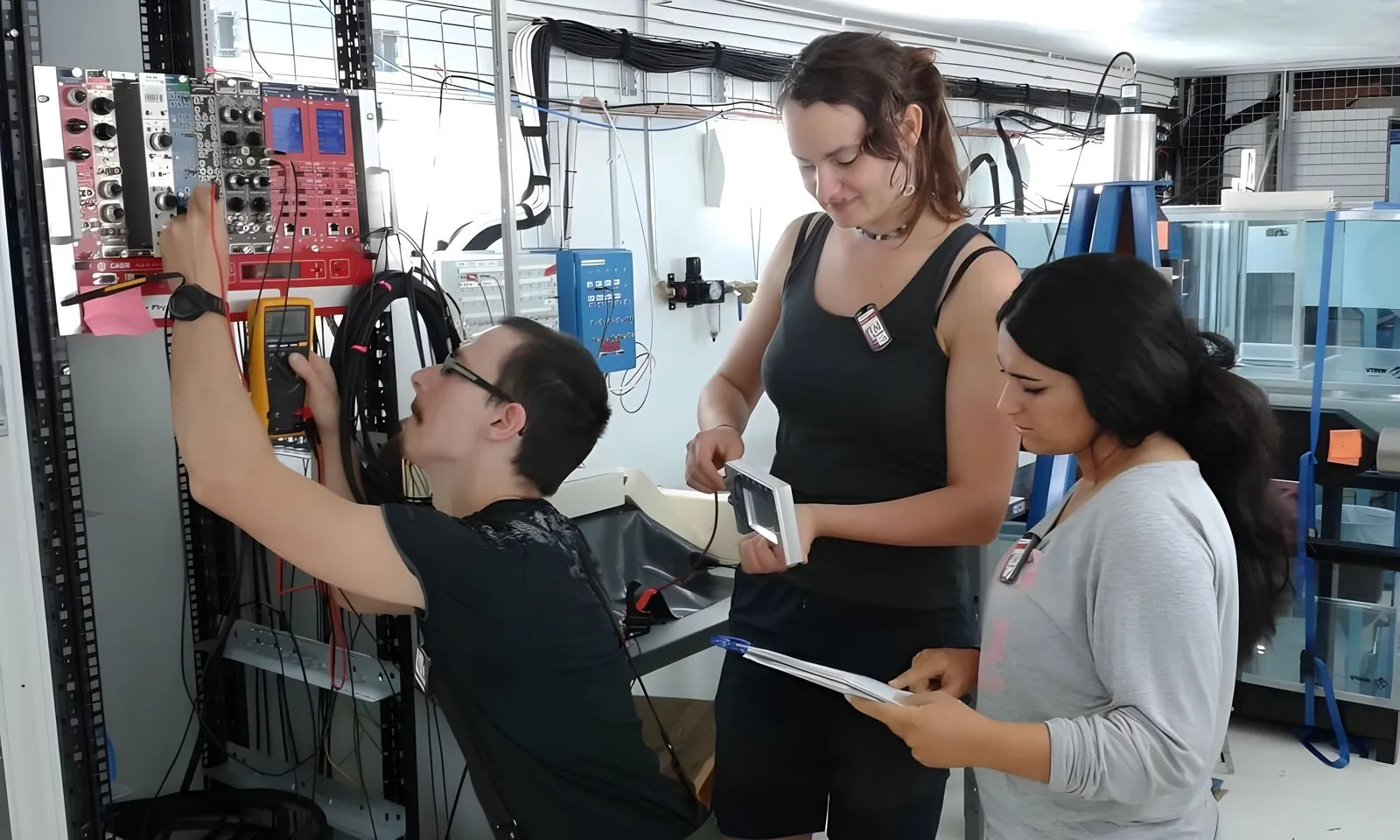 Detector test with colleagues at the Source Testing Facility (Lund, Sweden).
ORCID: 0000-0002-2791-0659
Journal articles
Light-yield response of liquid scintillators using 2–6 MeV tagged neutrons
Nuclear Instruments and Methods in Physics Research Section A: Accelerators, Spectrometers, Detectors and Associated Equipment, 2024link
[why this was interesting — to be added]
Nuclear Instruments and Methods in Physics Research Section A: Accelerators, Spectrometers, Detectors and Associated Equipment, 2023DOI
[why this was interesting — to be added]
First evaluation of a novel ionisation chamber for thermal neutron beam monitoringfirst author
EPJ Techniques and Instrumentation, 2022
[why this was interesting — to be added]
Nuclear Instruments and Methods in Physics Research Section A: Accelerators, Spectrometers, Detectors and Associated Equipment, 2022DOI
[why this was interesting — to be added]
GEANT4-based calibration of an organic liquid scintillator
Nuclear Instruments and Methods in Physics Research Section A: Accelerators, Spectrometers, Detectors and Associated Equipment, 2022DOI
[why this was interesting — to be added]
Response of a Li-glass/multi-anode photomultiplier detector to collimated thermal-neutron beams
Nuclear Instruments and Methods in Physics Research Section A: Accelerators, Spectrometers, Detectors and Associated Equipment, 2021DOI
[why this was interesting — to be added]
Simulation of the response of the Solid State Neutron Detector for the European Spallation Source
Nuclear Instruments and Methods in Physics Research Section A: Accelerators, Spectrometers, Detectors and Associated Equipment, 2021DOI
[why this was interesting — to be added]
Vanadium-based neutron beam monitorfirst author
Phys. Rev. Accel. Beams, 2020DOI
[why this was interesting — to be added]
Response of a Li-glass/multi-anode photomultiplier detector to focused proton and deuteron beams
Nuclear Instruments and Methods in Physics Research Section A: Accelerators, Spectrometers, Detectors and Associated Equipment, 2020DOI
[why this was interesting — to be added]
Time-and energy-resolved effects in the boron-10 based Multi-Grid and helium-3 based thermal neutron detectors
Measurement Science and Technology, 2020
[why this was interesting — to be added]
EPL (Europhysics Letters), 2020DOI
[why this was interesting — to be added]
Response of a Li-glass/multi-anode photomultiplier detector to α-particles from 241Am
Nuclear Instruments and Methods in Physics Research Section A: Accelerators, Spectrometers, Detectors and Associated Equipment, 2019DOI
[why this was interesting — to be added]
Parallel-Coupled Quantum Dots in InAs Nanowires
Nano Letters, 2017DOI
[why this was interesting — to be added]
Conference proceedings & talks
The 42th RD50 workshop, Tivat, Montenegro, June 20-23, 2023talklink
[why this was interesting — to be added]
40th RD50 workshop, CERN, Geneva, Switzerland Jun 21 – 24, 2022, 2022talklink
[why this was interesting — to be added]
The 41th RD50 workshop, Seville, Spain, November 29, 2022, 2022talklink
[why this was interesting — to be added]
Non-Ionizing Energy Loss in Silicon - Revisited
RADAC beginning of a year meeting, CERN, Geneva, Switzerland invited talk 26 Jan 2022, 2022talklink
[why this was interesting — to be added]
Study of NIEL partition into cluster and isolated defects using G4 and OPTICS
ATLAS Radiation Simulation WG, 15 Nov 2022, invited talk, 2022talklink
[why this was interesting — to be added]
The 39th RD50 workshop, Valencia, Spain, 17-19 Nov 2021, 2021talklink
[why this was interesting — to be added]
Vanadium-based neutron beam monitor update
IKON18: The Eighteenth In-Kind Contributions Meeting for Neutron Science for Instruments, February 25, 2020talklink
[why this was interesting — to be added]
IKON17: The Seventeenth In-Kind Contributions Meeting for Neutron Science for Instruments, September 11, 2019talklink
[why this was interesting — to be added]
Neutron beam Monitors at ESS
Proceedings of European Conference on Neutron Scattering, Saint Petersburg, July 2, 2019poster
[why this was interesting — to be added]
The neutron tagging facility at Lund University
2017arXiv
[why this was interesting — to be added]
Theses
Vanadium-based neutron-beam monitor
2019link
[why this was interesting — to be added]
Simulation and transport studies on quantum dots with variable shape
2017link
[why this was interesting — to be added]
Technical deliverables
2018DOI
[why this was interesting — to be added]
Simulation Tools for Detector and Instrument Design
2018DOI
[why this was interesting — to be added]